Padel or Tennis for a Group Trip? How They Compare
For a group with mixed levels, choose padel. It is always played as doubles, the court is small and enclosed, and a beginner can play real points in the first session. Choose tennis if everyone in the group already plays tennis and wants to work on their tennis.
Padel Stays runs padel trips, not tennis trips, so read this as a view from one side of the net. Where tennis is the better choice, I've said so.
What is the difference between padel and tennis?
The two sports share a scoring system and not much else.
- Players: padel is always doubles, so four people share a court. Tennis is singles or doubles.
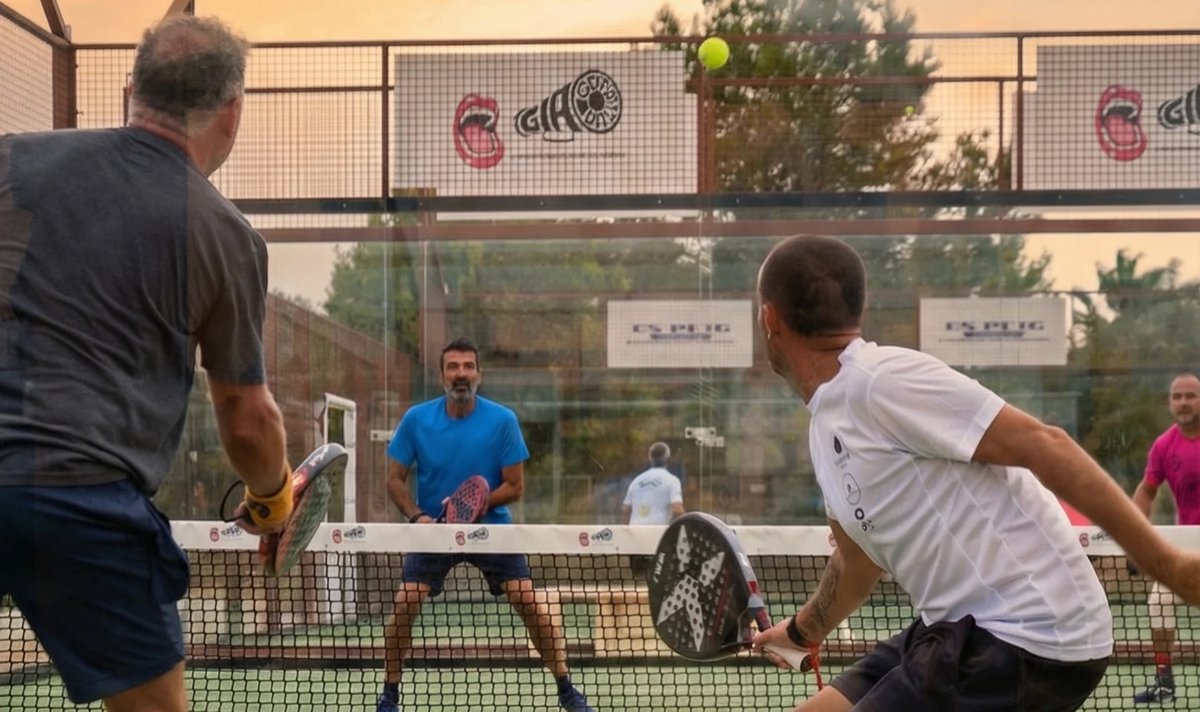
- Court: a padel court is smaller than a tennis court and enclosed by glass and mesh. The ball stays in play off the walls.
- Serve: padel uses an underarm serve. Tennis uses an overarm serve, which takes most people a long time to learn.
- Racket: a padel racket is solid, short and has no strings. It is easier to control from the first hit.
Which is easier for beginners?
Padel. The underarm serve gets the ball in play, the short racket is easy to handle and the walls keep rallies alive. Most people are playing points within their first session. On our trips, beginners are coached in their own group and play real points on the first morning.
Tennis asks for more before it gets fun. A new player needs a serve, a rally shot and a lot of court coverage before a game holds together. On a short trip, that can mean a beginner spends most of the time in drills.
Padel is easy to start and hard to master. Good players use the walls, the lob and the net in ways that take years to learn, so the strong players in your group won't be bored.
Which works better with mixed levels?
Padel, by some distance. Because it is doubles on a small court, players can be grouped by level and still feel part of one group. Four players of a similar level make a good match, whatever that level is.
On our trips, players are grouped by level for coaching and matches, and the whole group is together for everything else. We wrote a full guide to planning a padel trip for a mixed-ability group.

Which is more social?
Padel. Four people stand close enough to talk between points, partners rotate, and a round is short enough that everyone plays with everyone. That is why companies and founders use it to get people together, and why people ask whether padel is the new golf.
It also makes group formats easy. In an Americano, partners rotate every round and each player scores as an individual, so a group of 12 or more gets one shared tournament. See our guide to group padel tournament formats.
What about the tennis players in the group?
They tend to pick padel up fast. Volleys, overheads and reading the ball all carry over. The walls are the new part, and learning to let the ball go past and play it off the glass takes a few sessions. Most tennis players enjoy that there is something new to learn.
When is tennis the better choice?
Tennis is the better choice in three cases:
- Everyone in the group already plays tennis, for example a tennis club trip
- The group wants technical coaching on their tennis, or wants to play singles
- Nobody is new to racket sports, so the slow start doesn't apply
If that is your group, book a tennis trip with a tennis specialist. We don't run them.
Padel and tennis for group trips compared
| Padel | Tennis | |
|---|---|---|
| Players per court | Always four | Two or four |
| Court | Small and enclosed, with walls in play | Larger and open |
| Serve | Underarm | Overarm |
| Beginners | Playing points in the first session | Need more time before a game holds together |
| Mixed levels | Easy to group by level and keep the group together | Harder: level gaps show quickly |
| Social side | Close, talkative, partners rotate | More distance, more focus on the match |
| Group tournament | Simple with an Americano | Needs more courts and more time |
| Best for | Mixed groups, companies, clubs, friends | Groups of established tennis players |
How does a group padel trip run?
On our Ibiza trips, mornings are on court: about four hours of coaching and match play by level, with rests. Then lunch at the club and the rest of the day off for the pool, the spa or the beach. The last morning is the tournament. There's more on the padel in coaching and matches on a padel trip, and the Ibiza page shows a full trip.
FAQ
Is padel easier than tennis?
Padel is easier to start. The serve is underarm, the court is small and the walls keep the ball in play. It is still hard to master, so strong players stay challenged.
Can complete beginners join a group padel trip?
Yes. On our trips, beginners are coached in their own group and play real points in their first session.
Do tennis players enjoy padel?
Most do. Volleys and overheads carry over, and using the walls gives them something new to learn.
How many players do we need for a padel trip?
Twelve or more on our trips. Padel is played four to a court, so 12 players fill three courts and every round is a full match.
Does Padel Stays run tennis trips?
No. We plan group padel trips only. For a tennis trip, use a tennis specialist.
Can people come who do not want to play every session?
Yes. There is always the spa, the pool, yoga or a guided hike.
Planning a trip for a mixed group? Tell us who is coming, roughly when, and how they play, and we'll plan the padel around your levels. Start on the group padel trips page or book a call.